 By Lee Eugene
Your pool is only the beginning. Here’s how to build an outdoor living space that’s every bit as beautiful and functional as the one inside your home.
A swimming pool is one of the most significant investments a homeowner can make, yet so many pools sit in backyards that feel unfinished, a beautiful focal point surrounded by… not much else. The good news is that outdoor design has never been more intentional, and today’s poolscapes are reimagining what a backyard can actually do.
Whether you’re working with a pool installation company to start from scratch or upgrading an existing setup, these five features will turn your pool area into a fully realized outdoor living space worth spending every warm evening in.
- An Outdoor Kitchen That Actually Gets Used
There’s a version of the outdoor kitchen that exists on a Pinterest board and rarely anywhere else: the stainless steel grill island with the built-in refrigerator that gets used twice a summer. Then there’s the outdoor kitchen designed around how a family actually cooks and gathers.
The difference is almost always in the planning. A poolscape kitchen earns its place when it’s positioned close enough to the action that the cook doesn’t feel exiled to a corner of the yard, but thoughtfully separated enough to keep smoke and heat away from the water. The functional baseline most designers work from is a 36-inch built-in gas grill, a 24-inch single-basin sink with a pull-down spray faucet, and roughly 8 to 10 linear feet of prep counter surface. That’s the floor, not the ceiling. From there, an outdoor-rated beverage cooler, an undercounter refrigerator for condiments and marinades, and a two-burner side station for sauces or sides will handle nearly any outdoor meal without requiring a trip back inside.
Covered kitchen setups are particularly popular right now, and for good reason. Even a simple pergola overhead, paired with a ceiling fan rated for damp locations, extends the usability of an outdoor kitchen well into fall in most climates. For homeowners in regions where mild weather stretches into November, a propane patio heater or two can push that window even further, effectively turning the outdoor kitchen into a three-season room that’s genuinely woven into everyday life rather than reserved for the height of summer.
Avoid this: Positioning the kitchen along the far perimeter of the yard to “keep it out of the way” is one of the most common layout mistakes in poolscape design. A kitchen tucked into a back corner creates a dead zone that pulls the host away from the gathering. Keep it within 15 to 20 feet of the primary seating area, and the space will actually function the way you planned it.
- A Pavilion or Pergola That Creates a Destination
A well-designed poolscape needs shade, and the way you provide that shade says a great deal about the overall design intention of the space. Umbrellas are practical but temporary. A freestanding pavilion or attached pergola communicates permanence, and it gives the backyard a genuine architectural anchor.
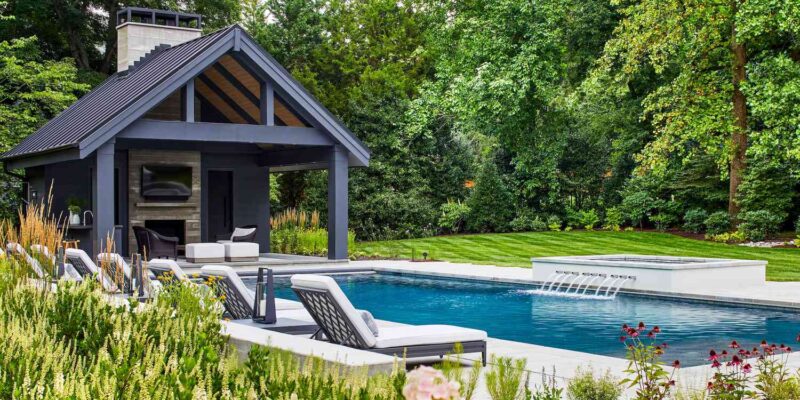
Pergolas work beautifully when they’re positioned to frame a seating area adjacent to the pool rather than over the water itself. String lights threaded through the rafters, a ceiling fan for airflow, and a set of comfortable outdoor sectional furniture turn the space underneath into a room, one that happens to be outside.
Pavilions take that concept further by adding a solid or slatted roof, built-in lighting, and sometimes fully enclosed sides that can be screened or outfitted with roll-down shades. These structures are particularly valuable in regions with unpredictable summer weather, giving homeowners a covered retreat without surrendering the connection to the outdoors.
Here’s an honest take most design guides won’t give you: for the majority of homeowners, a well-built pergola will outperform a pavilion over the long run. Pavilions are striking, but they’re also significantly more expensive to build properly, require more permitting in most municipalities, and can feel visually heavy in a mid-sized backyard. A cedar or ipe pergola with 6×6 posts, a 2×6 rafter system, and quality hardware is a more versatile investment and, in the right hands, just as beautiful. Save the full pavilion build for lots with the square footage to justify it.
The material choices matter considerably, and they reward the same kind of careful thought that goes into selecting interior finishes. Cedar weathers to a silver-gray patina over time that many homeowners come to prefer. Powder-coated aluminum in a matte finish requires almost no maintenance and holds up exceptionally well in humid or coastal climates. Composite decking brands like TimberTech and Trex have expanded into pergola systems in recent years and now offer a convincing middle ground for homeowners who want the warmth of wood without the upkeep. A pergola built to complement the home’s existing architecture, rather than compete with it, will feel like it was always part of the plan.
- Hardscaping That Ties the Whole Space Together
The pool deck is the foundation of the poolscape, and the material it’s made from sets the tone for everything else. Concrete is durable and versatile, but stamped or broom-finished concrete can feel dated quickly. Natural stone ages gracefully and brings a texture and warmth to the space that manufactured materials rarely replicate.
For years, travertine was the go-to recommendation in this category, and it’s still a solid choice. Its natural porosity keeps the surface cooler underfoot on hot days, and its earthy tones work with nearly any architectural style. The honest reality, though, is that travertine has become so prevalent in new pool construction that it can read as the default rather than a considered decision. Designers are increasingly reaching for Jerusalem limestone, Lueders limestone, and honed bluestone as alternatives that offer similar performance characteristics with a fresher visual profile. Bluestone in particular skews slightly more formal and makes a strong statement in traditional or transitional homes.
Beyond the immediate pool surround, thoughtful hardscaping extends the outdoor living area outward. A secondary patio zone positioned away from the water gives guests a quieter spot to sit and decompress, and in larger backyards it creates a natural separation between the active energy of the pool and the more relaxed atmosphere of a lounge or conversation area. Pathways that connect the pool to a fire feature, a garden, or a kitchen area create natural movement through the yard. Retaining walls, built-in benches, and raised planters add dimension to a flat lot and contribute a sense that the space was designed rather than assembled.
- A Water Feature That Adds Sound and Movement
One of the most underrated additions to any poolscape is a water feature, not because of how it looks, but because of how it sounds. The ambient noise of moving water has a way of masking street noise, neighboring yard sounds, and the general hum of suburban life. A poolscape with a well-placed water feature feels removed from the world in a way that’s genuinely hard to achieve otherwise.
Spillover spas are the most functional iteration of this idea. A raised spa that spills into the pool creates constant movement and sound, adds a visual focal point at one end of the pool, and provides the hydrotherapy benefits of a hot tub without requiring a separate, standalone structure. The spillway width matters more than most people realize: a 24- to 36-inch sheet waterfall creates a genuinely dramatic visual and acoustic effect, while a narrow 12-inch spillway can look a little underwhelming once the pool is filled and photographed. Sheet waterfalls built into a raised bond beam or retaining wall achieve a similar effect with a more architectural profile and tend to photograph exceptionally well.
For homeowners who want something more sculptural, a freestanding fountain or a cast-stone bubbling urn positioned near a seating area accomplishes the same acoustic goals at a fraction of the cost. The key is intentionality: a water feature placed thoughtlessly in the corner of a yard will feel like an afterthought, while one positioned to be seen and heard from the primary gathering areas becomes a genuine design statement.
- Landscape Lighting That Extends the Evening
The most beautiful poolscape in the world disappears after dark if it isn’t lit well, and lighting is one of the most transformative investments a homeowner can make relative to its cost. Layered landscape lighting, meaning a combination of hardscape uplighting, path lighting, in-water LED fixtures, and overhead string or pendant lighting, turns a daytime pool area into an entirely different kind of space once the sun goes down.
Underwater LED pool lights are a baseline expectation at this point, and the better systems, Pentair’s IntelliBrite and Hayward’s ColorLogic are the two most widely specified by pool designers, allow color temperature adjustments that shift the mood of the water from a cool 6500K white to a warmer 2700K evening ambiance. Beyond color control, modern LED systems consume a fraction of the energy that older halogen fixtures required and can be managed through a smartphone app, making it practical to adjust the lighting from a lounge chair without getting up. That combination of efficiency, flexibility, and ease of use has made LED the default choice for new pool builds and a compelling upgrade for homeowners replacing aging fixtures. Above the waterline, low-voltage path lights keep the deck safe and usable without flooding the space with light. Uplighting installed at the base of mature trees or along a privacy wall adds drama and depth that no amount of overhead lighting can replicate.
The overhead layer deserves particular attention in covered structures. A pavilion or pergola fitted with dimmable 2700K string lights creates an atmosphere that no other light source quite matches. A few well-placed outdoor sconces on a fence line or exterior wall provide functional illumination while contributing to the overall composition of the space. The goal is for the yard to feel lit, not bright, and that distinction is what separates a space that’s been designed from one that’s been merely illuminated.
Where It All Comes Together
None of these features has to arrive all at once. Plenty of homeowners start with great hardscaping and lighting, then add a pergola a few years later and a spillover spa after that. The poolscape, at its best, is something that grows with the way a family uses the space rather than something delivered fully formed on a single project timeline.
What the best outdoor living spaces share isn’t a particular material palette or a specific list of features. It’s a sense of intention, the feeling that every element was chosen to relate to the others and to the people who actually spend time there. A kitchen that’s in the right place. Shade that makes the afternoon comfortable. Light that makes the evening worth staying for. When those things come together, the backyard stops being an afterthought to the home and starts being one of its best rooms.