
 By Lee Eugene
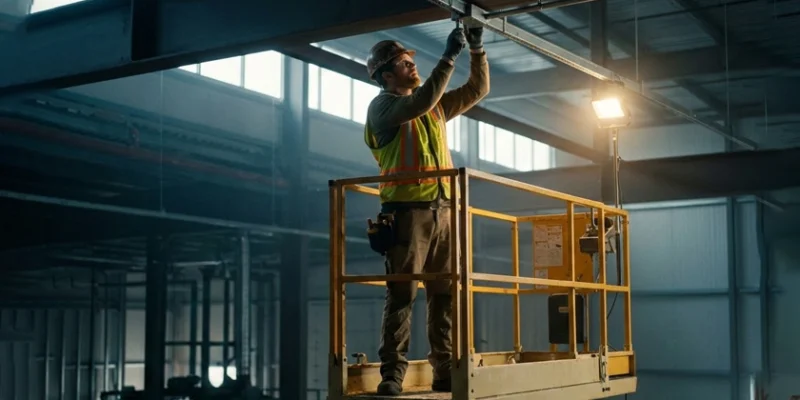
Walk through almost any active construction site, warehouse renovation, or large-scale maintenance project today, and you’ll notice a common sight: workers elevated safely above ground level, moving steadily along compact platforms as they handle tasks that once required ladders, scaffolding, and a great deal of risk. These platforms—scissor lifts—have quietly become one of the most important tools in modern industrial work.
But behind every successful elevated job is a decision that often goes unnoticed: whether to purchase or opt for a scissor lift rental. Increasingly, businesses of all sizes are choosing the latter, and not just for cost reasons. The decision reflects a broader shift toward flexibility, safety, and smarter project planning.
The Evolution of Working at Height
For decades, working at height was synonymous with physical strain and elevated risk. Ladders were unstable, scaffolding required significant setup time, and both limited mobility and productivity. The introduction of mobile elevated work platforms (MEWPs), particularly scissor lifts, changed that dynamic entirely.
A scissor lift operates using a crisscrossing metal support structure that expands vertically, raising a stable platform for workers and materials. Unlike boom lifts, scissor lifts move only straight up and down, which makes them especially useful for tasks requiring steady, vertical elevation, such as ceiling repairs, electrical installation, signage work, and facility maintenance.
Over time, industries from construction to warehousing began relying on them not just for convenience, but for safety and efficiency.
Why Rentals Have Become the Industry Standard
Owning heavy equipment used to be considered a sign of operational strength. Today, however, many contractors and facility managers are rethinking that assumption.
A key reason is simple: most projects don’t require continuous access to a scissor lift. Instead of investing tens of thousands of dollars in ownership, businesses are increasingly turning to rental solutions that allow them to access the right equipment only when needed.
A modern scissor lift rental offers flexibility in several ways:
- Short-term access for specific projects
- The ability to choose different lift heights and capacities per job
- Reduced maintenance responsibility
- No long-term storage requirements
Rental providers typically maintain and inspect equipment before each use, ensuring machines are in optimal working condition and compliant with safety standards. This reduces downtime and minimizes risk for operators on site.
Matching the Machine to the Mission
One of the most important, but often overlooked, advantages of renting is selection.
Not all scissor lifts are created equal. Depending on the job, operators may need different specifications such as working height, platform size, and terrain capability. For example, indoor maintenance tasks might require compact electric lifts designed for smooth flooring, while outdoor construction projects often demand rough-terrain models capable of handling uneven ground and higher weight loads.
Industry guides emphasize that selecting the wrong lift can slow down work and increase risk, which is why proper assessment of job site conditions is essential before choosing equipment.
Rental providers help bridge this knowledge gap by offering a range of equipment tailored to specific environments, ensuring crews get exactly what they need without overinvesting in unnecessary capacity.
Safety: The Core Reason Behind Their Use
Beyond convenience and cost, safety remains the most compelling reason scissor lifts are widely adopted.
Unlike scaffolding, which requires assembly and can be affected by weather or structural instability, scissor lifts offer a built-in, guarded platform that reduces fall risk. They are designed with safety rails, controlled elevation systems, and stable bases that help prevent tipping when used correctly.
However, safety is not automatic, it depends heavily on proper training. Operators must understand load limits, ground conditions, and environmental hazards such as wind or overhead obstructions.
Common risks include:
- Uneven or unstable ground surfaces
- Overloading the platform
- Contact with power lines
- High wind conditions during outdoor use
Because of these risks, many jurisdictions require formal training or certification before operating a lift. This ensures that users are not only technically capable but also aware of how to respond in emergency situations.
Cost Efficiency Beyond the Price Tag
At first glance, renting might seem like a recurring expense. But when viewed through a broader operational lens, it often proves more economical than ownership.
Consider the hidden costs of owning equipment:
- Routine maintenance and repairs
- Insurance and compliance costs
- Storage space requirements
- Equipment depreciation
- Idle periods between projects
Renting eliminates many of these factors. Companies only pay for the time they actually use the equipment, which can significantly improve cash flow and project budgeting.
Rental pricing also scales with project needs. A small indoor job may only require a compact lift for a day or two, while larger construction projects can access higher-capacity machines for longer durations without committing to purchase.
Productivity Gains on the Job Site
Efficiency is another major advantage.
Scissor lifts reduce the time required to complete elevated tasks by allowing workers to carry tools and materials directly to the work area. Instead of climbing up and down repeatedly, crews can remain safely positioned on the platform and move horizontally as needed within the workspace.
This translates into:
- Faster task completion
- Reduced physical fatigue
- Fewer interruptions in the workflow
- Improved coordination among team members
On large commercial projects, these gains can significantly reduce overall timelines.
The Role of Professional Rental Providers
Behind every reliable lift rental is a structured support system. Reputable rental companies don’t just provide equipment, they provide guidance.
This includes:
- Helping clients select the right lift type
- Ensuring compliance with safety regulations
- Offering maintenance support and inspections
- Providing replacement equipment if needed
This support is especially valuable for businesses that may not have in-house equipment specialists.
One example of a provider offering scissor lift rental services is accessible through platforms like BigRentz, where a range of lift options can be matched to different project requirements.
Looking Ahead: Smarter, Safer Work at Height
As industries continue to modernize, the emphasis is shifting toward smarter equipment use rather than ownership. Sustainability concerns, rising operational costs, and increased safety regulations are all contributing to this change.
Electric scissor lifts, improved battery technology, and more efficient hydraulic systems are also shaping the future of elevated work platforms. These advancements are making equipment quieter, cleaner, and more adaptable to both indoor and outdoor environments.
In many ways, the humble scissor lift has become a symbol of how modern industry approaches problem-solving: practical, safety-focused, and increasingly flexible.
Conclusion: A Lift That Reflects a Larger Shift
The rise of scissor lift rentals is not just about equipment access; it reflects a broader transformation in how work is planned and executed. Businesses today are prioritizing adaptability over ownership, safety over speed, and efficiency over tradition.
Whether used in construction, warehousing, or facility maintenance, scissor lifts have become essential tools for getting work done safely and effectively at height. And for many organizations, renting them is no longer a backup plan; it’s the standard approach.