 By Lee Eugene
Modern interior architecture often falls victim to its own precision. Expansive glass panes, polished concrete, razor-sharp drywall reveals, and relentless white paint can produce rooms that look striking on a screen but feel unyielding in person. When clean lines cross the line into clinical emptiness, spaces lose their sense of shelter. They become showrooms rather than sanctuaries, leaving inhabitants feeling unsettled by echoing acoustics, cool reflections, and an absence of human touch.
The solution is not to abandon modernism for fussy traditional ornamentation. Instead, the design world has embraced organic modern design, an aesthetic philosophy that balances the discipline of minimalist architecture with the restorative warmth of the natural world. By introducing raw textures, biomorphic forms, and earthy palettes into crisp architectural shells, this approach transforms sterile interiors into grounded, deeply comforting living environments.
Grounding the Canvas: Shifting from Stark Whites to Tonal Earthiness
The quickest path to a sterile room is an unconsidered paint deck. High-reflectance, cool-toned white paint—often chosen to make rooms feel expansive—routinely pulls blue or gray undertones under natural daylight, making open layouts feel hollow.
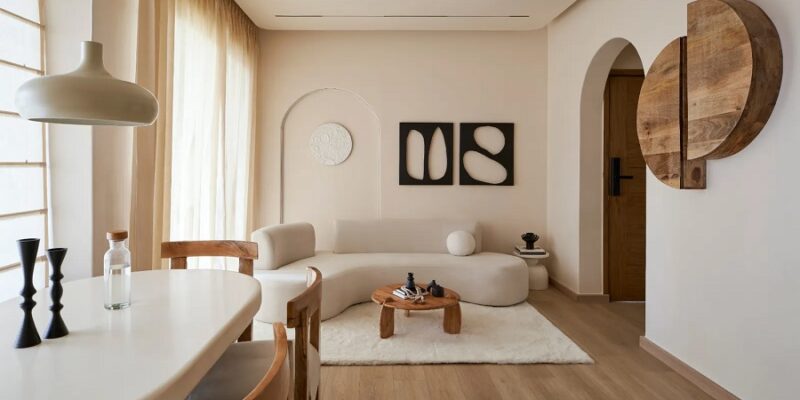
Organic modern spaces replace harsh whites with complex, warm-based neutrals. Think of the mineral tones found in river valleys and arid landscapes: chalk, oat, travertine, bleached linen, and warm greige. These shades absorb and scatter light rather than bouncing it aggressively across bare drywall.
To prevent a neutral palette from falling flat, designers build tonal depth rather than relying on high contrast. Instead of placing black accents against pure white walls, an organic modern scheme layers close-value hues: bone walls paired with a camel wool throw, sand-toned drapery, and deep espresso or walnut trim. Introducing grounded earth pigments—such as terracotta, tobacco, moss, and oxidized ochre—gives the eye points of rest without disrupting the quiet simplicity of the room.
The Tactile Remedy: Building Dimensionality Through Raw Texture
A room feels sterile when every surface shares the same sensory register: smooth, flat, and non-reactive. When fingers touch laminate, glass, or polished drywall, the brain registers an artificial environment. Restoring warmth requires an intentional sensory dialogue between contrasting materials.
Layering Textiles with Character
Fabric selection plays a foundational role in dampening reverberant noise and softening visual hardness. Rather than smooth synthetic blends, organic modern rooms depend on textiles with slub, tooth, and visible grain.
Heavy, unpressed Belgian linen window treatments soften rigid window casings while filtering harsh glare into diffuse daylight. Upholstery leans into chunky bouclé, brushed wool, raw silk, and textural shearling. On the floor, low-pile or high-twist wool rugs, braided jute, and vintage hand-knotted flatweaves provide a tactile foundation underfoot that visually anchors floating furniture arrangements.
Embracing Porous, Living Finishes
Wall surfaces benefit immensely from hand-applied finishes that reject machine uniformity. Limewash paint, Roman clay, and subtle Venetian plaster introduce a velvety, suede-like finish that shifts gently as sunlight moves across the room. These treatments eliminate the sterile plastic sheen of standard latex paint.
The same principle extends to hard finishes. Swap glossy engineered quartz for honed limestone, fluted travertine, or porous soapstone. Unlacquered architectural metals—such as living brass, blackened bronze, and gunmetal—develop a distinctive patina over years of contact, quietly recording the life of the home.
Softening the Grid: Introducing Curves and Biomorphic Forms
Traditional modernism is rooted in Euclidean geometry: straight axes, crisp right angles, and parallel lines. When repeated across an entire home, these rigid contours create visual fatigue. Nature rarely builds in straight lines, which explains why the human eye instinctively relaxes when encountering organic contours.
Softening a sterile room requires breaking up the box. Consider replacing a severe, rectangular dining table with a rounded oval surface cut from solid oak, or pairing a streamlined sofa with a pair of curved swivel armchairs.
Architectural curves also create moments of pause within open-concept layouts:
-
Arched transitions that soften the boundary between living zones
-
Curved kitchen islands with fluted timber detailing on the base
-
Organic, freeform coffee tables that encourage natural circulation paths
-
Sculptural ceramic vessels that celebrate wabi-sabi asymmetry and rough, hand-pinched surfaces
By scattering gentle curves throughout a structured floor plan, you guide the eye smoothly across the space rather than stopping it abruptly at sharp corners.
The Grounding Presence of Unfinished and Character-Rich Wood
Timber is the soul of organic modern interiors. However, the treatment of the wood makes all the difference. High-gloss lacquers, reddish cherry stains, and yellowed oak veneers can look dated or synthetic.
Organic modern spaces celebrate open-grain hardwoods with low-sheen, matte finishes. White oak, American walnut, and reclaimed elm are prized for their visible growth rings, distinct knots, and natural mineral streaks. These characteristics remind occupants of the material’s living origins.
In an overly clean room, introducing a single monumental piece of wood creates an instantaneous shift in atmosphere. A thick-cut slab bench in an entryway, a reeded timber console, or an untreated burl-wood accent table grounds surrounding contemporary elements. The natural warmth of timber tempers the coldness of structural concrete and architectural glass, establishing an effortless visual dialogue between natural craft and contemporary restraint.
Ambient Illumination: Banishing the Overhead Glare
Nothing amplifies an impression of clinical sterility faster than aggressive, cool-toned overhead lighting. High-lumen recessed downlights positioned across a ceiling generate harsh vertical shadows, flatten architectural textures, and produce a commercial, office-like glare.
To cultivate a relaxed, restorative environment, lighting must be treated as a layered atmospheric composition:
-
Select warm color temperatures. Keep interior bulbs strictly within the 2400K to 2700K range. This golden light mimics sunrise and twilight, triggering an innate biological relaxation response.
-
Ditch the ceiling grid for low-level pools of light. Position table lamps, sculptural floor fixtures, and wall sconces at varying heights between four and six feet from the floor. This creates intimate ambient islands that invite conversation.
-
Use shades made from natural, light-filtering mediums. Lantern pendants constructed from Japanese washi paper, pendants made from spun fiberglass or woven raffia, and sconces carved from translucent alabaster stone diffuse electric glare into a soft, ambient glow.
By turning off high-intensity ceiling fixtures and illuminating architectural corners with warm accent lighting, the room sheds its clinical atmosphere the moment dusk arrives.
Integrating Living and Sculptural Greenery
Indoor plants are essential to biological comfort, but filling an interior with dozens of small, mismatched nursery pots can create visual noise that clashes with modern simplicity. Organic modern design takes a more curated, architectural approach to indoor flora.
Instead of cluttered groupings, focus on one or two striking, large-scale plant specimens housed in substantial, unglazed earthenware vessels. A mature Japanese maple in a sunlit atrium, a structural fiddle-leaf fig, or an airy olive tree adds organic height and softens empty vertical walls.
For dining tables, entry consoles, and deep window reveals, sculptural branches offer an effortless alternative to ornate floral arrangements. A bundle of seasonal magnolia stems, delicate dogwood branches, or bare quince boughs placed inside an aged stone urn introduces sculptural height, organic shadow patterns, and a tangible link to the outdoors without disturbing the room’s serene visual discipline.
A sterile interior is rarely an irreparable failure; it is simply an incomplete space waiting for human and biological connection. By paring back artificial shine, welcoming organic imperfection, and prioritizing tactile materials over mass-produced finishes, you can preserve the clean serenity of modern architecture while providing a home that feels warm, enduring, and effortlessly inhabited.
What is your reaction?
Excited
0
Happy
0
In Love
0
Not Sure
0
Silly
0